Barnsley’s Small Businesses Are Being Squeezed
Why Independent Traders Across Every Ward Are Under Pressure
Across Barnsley, small businesses are doing what they have always done. Opening early. Closing late. Putting everything they have into serving their communities.
They are not asking for sympathy.
They are asking for room to survive.
Behind almost every independent café, shop, salon, trades business or service provider in this borough is not a management team or a corporate structure. It is usually one person, or a couple, doing everything.
They clean up.
They serve customers.
They manage stock.
They run social media.
They answer emails late at night.
They do accounts at weekends.
They carry all the risk personally.
This is the reality of small business life in Barnsley.
Small Businesses Do Not Operate Like Corporations
A small business does not have departments, buffers or spare capacity. It does not have legal teams, HR teams or cash reserves sitting idle.
Many are one person operations. Others employ a handful of staff and take full responsibility for wages, tax, compliance and overheads themselves.
When something goes wrong, it is not written off. It comes directly out of their own pocket.
Yet policy is too often designed as if every business operates like a large corporate organisation.
It does not.
Rising Costs Are Crushing Independent Businesses
Small businesses across Barnsley are being hit from every direction.
Higher National Insurance.
Rising wage bills without matching productivity support.
Soaring energy costs.
Business rates that do not reflect local footfall.
More regulation.
More paperwork.
Less flexibility.
Many business owners are now working longer hours simply to stand still.
This is not about avoiding responsibility or resisting fair pay. It is about the cumulative impact of decisions made far away from the shop floor, by people who have never had to meet a payroll during a quiet winter month.
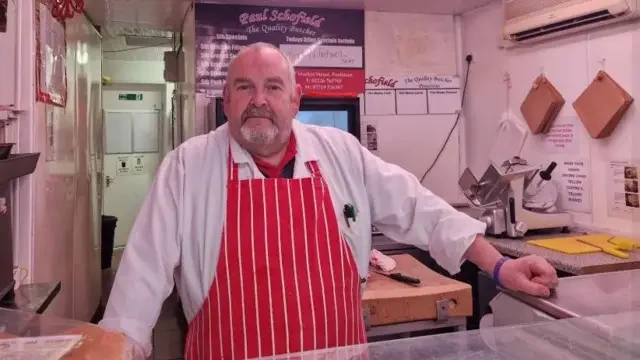
Paul Schofield The Quality Butcher
This Is Happening In Every Ward Across Barnsley
This is not a town centre only issue. It is being felt across the whole borough.
Penistone
In Penistone, the pressures facing small businesses are not theoretical. They are real, personal and increasingly visible.
Many local residents know Paul Schofield, who has worked as a butcher in Penistone for 35 years and ran The Quality Butcher for the past two decades. Paul recently announced the closure of his Penistone shop, a decision driven not by lack of effort or commitment, but by a long term decline in high street footfall, rising overheads and changing customer habits.
Paul has spoken openly about what has changed. Footfall has fallen significantly over the years. Energy bills have more than doubled. Staff costs, National Insurance and the minimum wage have all risen sharply. At the same time, fewer people are cooking traditional meals at home, with more customers opting for supermarkets or eating out instead.
As Paul put it plainly, “Everything’s gone sky high. Electric, gas, national insurance, minimum wage. We just can’t get nowhere.”
He also reflected on how different Penistone once was, when weekly cattle markets and livestock auctions brought people into the town centre and supported surrounding shops. Those markets never returned after the foot and mouth outbreak, supermarkets arrived, and over time many independent traders disappeared.
Paul’s story is not unique, but it is a powerful example of what is happening quietly across Barnsley. A skilled, hardworking local trader doing everything right, yet still forced to step back because the system around him no longer works.
You can read Paul’s full story here via the BBC:
https://www.bbc.co.uk/news/articles/cy5gdnpvr2no
Independent cafés, retailers and service businesses in Penistone rely heavily on regular local custom and passing trade. When costs rise and footfall dips, there is no buffer and no safety net.
Hoyland and Elsecar
In Hoyland and Elsecar, family run shops and trades face the same pressures while operating in areas already hit by reduced disposable income. Rising costs leave little room to adapt when margins are already tight.
Wombwell and Darfield
In Wombwell and Darfield, small businesses are dealing with increasing overheads while trying to survive on high streets that have experienced long term decline and reduced footfall.
Cudworth, Royston and Monk Bretton
In Cudworth, Royston and Monk Bretton, one person and micro businesses quietly keep communities going, often without recognition or meaningful support, absorbing pressure after pressure behind the scenes.
Barnsley Town Centre
In Barnsley town centre, independent traders compete not only with online retail, but also with regeneration decisions that have not delivered the promised increase in footfall needed to sustain them.
Different wards. Same pressures. Same reality.
Small businesses across Barnsley are doing everything asked of them. What they are not getting in return is a system that understands how close many of them are to the edge.
If policy does not change, the loss will not be abstract. It will be visible in shuttered shops, fewer local services and weaker communities in every ward.
Investment Comes From Pride, Not Excess
Small business owners are not stripping money out of their businesses to fund luxury lifestyles.
Most reinvest constantly.
New equipment.
Refurbishments.
Training.
Courses.
Improving customer experience.
They do this because they care. Because their name is above the door. Because their reputation matters in a borough where people know each other.
Walk into many independent businesses across Barnsley and you will see more pride, care and effort than in far larger organisations.
Listening Is Easy. Delivery Is What Matters
Politicians often say they are listening to small businesses. Listening is important, but it is also the easiest part.
The harder part is translating that listening into decisions that reflect how small businesses actually operate day to day.
Small businesses do not need slogans or staged visits. They need fewer barriers, lower fixed costs, simpler systems and breathing space to grow.
They need policy shaped by lived experience, not theory.
Customers Matter Too
This is not just about government. It is about us as residents.
If you book a table at a small restaurant, turn up.
If you book an appointment, keep it.
If you enjoy good service, say so.
Small business owners hear complaints loudly and praise quietly. Sometimes that encouragement is the only thing keeping someone going.
Supporting local does not automatically mean paying more. It often means better service, stronger communities and money staying in Barnsley.
Barnsley Deserves Better Than Spin
Small businesses are the backbone of Barnsley’s economy and its communities. Once they are gone, they rarely return.
They do not need to be told they are valued.
They need to be treated as if they matter.
That means policies rooted in reality.
It means understanding how fragile the middle ground has become.
And it means recognising that every closed shop is a permanent loss.
We have had enough spin. We will not be hoodwinked and we certainly will not stand for being gaslit ever again.
Making common sense, common again
